

In the world of tech unicorns, few stories are as compelling as Canva's ascent. What began as a simple design tool has exploded into a global powerhouse, boasting a staggering $42 billion valuation and commanding the attention of over 260 million monthly active users. While a brilliant product is one part of the equation, the true engine behind this astronomical growth lies hidden in plain sight: a masterfully executed SEO and content strategy.
This isn't just a story about blogging or keywords. It's about building a digital empire, brick by programmatic brick. We’re pulling back the curtain to reveal the sophisticated, multi-layered blueprint that Canva used to acquire an astonishing 128 million backlinks from over 600,000 domains and attract over 100 million organic visitors every single month.
Forget vague theories. We are reverse-engineering the exact machine. You'll learn how Canva weaponized search intent, built landing pages at an industrial scale, and launched a relentless outreach campaign. This is a deep dive into the operational playbook that transformed a startup into a legend—a playbook you can learn from.
Engineer a Flywheel by Targeting Granular Search Intent
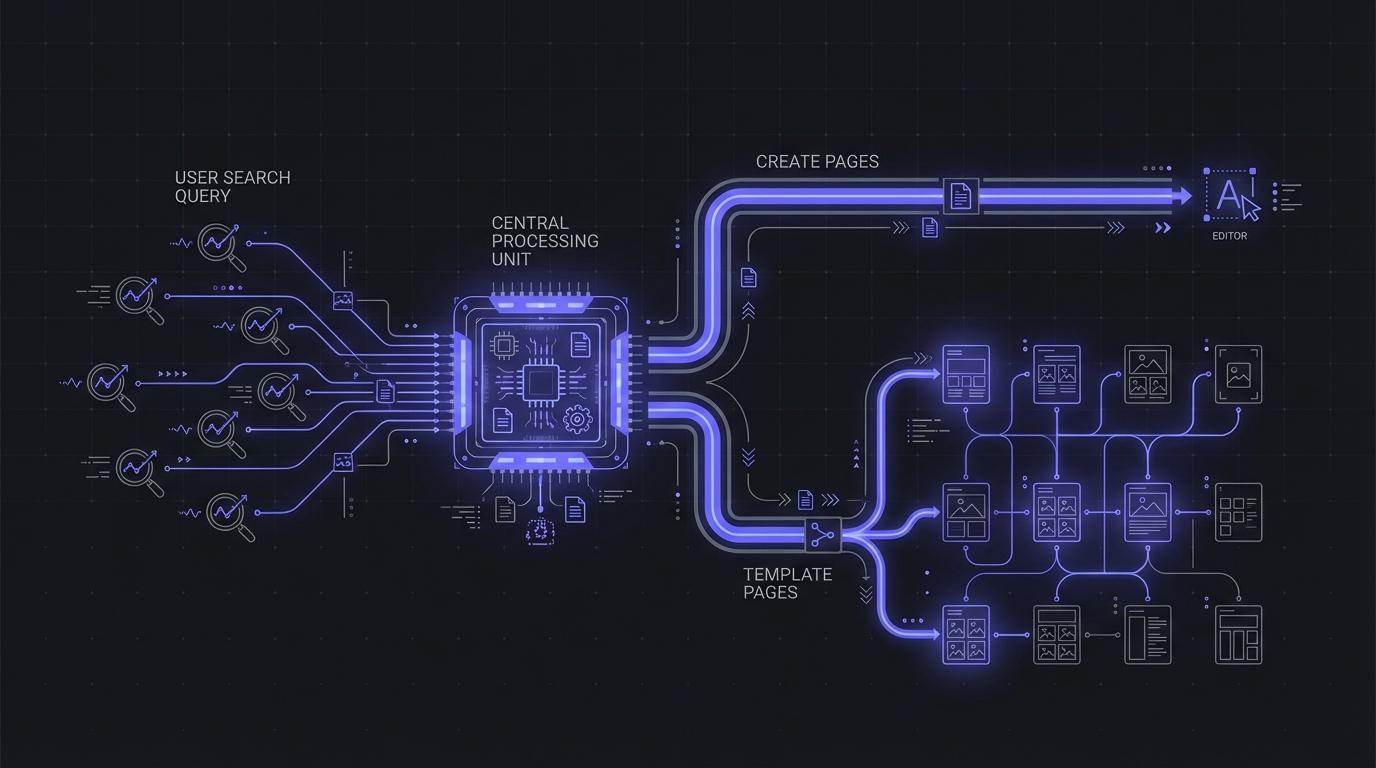
At the heart of Canva's SEO dominance is a profound understanding of a simple concept: user intent. They don't just target broad keywords; they dissect the user's entire journey and build dedicated, high-value pathways for every possible need. Their masterstroke was splitting the user's primary "transactional" intent into two distinct categories, creating a powerful pincer movement that captures a massive share of search traffic.
The first arm of this strategy is the "Create Page." These pages target users who know what they want to do. Their search query is action-oriented, like "design a business card" or "make a logo." The user is in an active, creative mindset. Canva serves them a landing page that is, for all intents and purposes, a simplified version of the product itself. It’s a direct ramp into the editor, designed for immediate action and conversion.
The second, and arguably more powerful, arm is the "Template Page." This caters to users who know what they want but are looking for inspiration or a shortcut. Their query is solution-oriented, like "business card templates" or "logo templates." They are in a discovery mindset. For these users, Canva presents a gallery-style page filled with a vast selection of pre-designed templates. It’s a visual feast that showcases the platform's value and variety before asking the user to commit to the editor.
This dual-pronged approach is a masterclass in market saturation. By creating two distinct entry points for nearly every design use case, Canva doubles its SERP real estate, appealing to different psychological triggers and stages of the user journey. The user who wants to build from scratch is satisfied, and the user who wants a pre-made solution is also captured. This isn't just building landing pages; it's a systematic conquest of search intent.
Construct a Scalable Content Directory for Niche Domination
Canva's strategy for targeting thousands of long-tail keywords isn't about writing individual blog posts. It’s an architectural marvel of programmatic SEO, built around a sophisticated parent-child content directory. This structure is the assembly line that allows them to produce targeted, high-ranking pages at an unbelievable scale.
Think of it as a pyramid. At the top sits a "Parent Page," representing a broad design category like "Invitations." This page acts as a central hub, but the real magic happens in the layer below: the "Child Pages." The "Invitations" parent page, for example, links out to 73 highly specific child pages: "wedding invitations," "birthday invitations," "baby shower invitations," "graduation invitations," and so on.
Each of these child pages is a hyper-targeted asset designed to rank for a very specific, long-tail keyword. Someone searching for "Christmas party invitation template" isn't just a generic Canva user; they are a high-intent lead with a specific, time-sensitive need. By creating a dedicated page for this exact query, Canva meets the user with unparalleled relevance.
The results of this structure are staggering. The "Invitations" category alone, with its dozens of child pages, captures over 900 backlinks and pulls in more than 65,000 organic visitors every single month. Now, multiply that effect across hundreds of other parent categories like "Resumes," "Social Media Posts," "Logos," and "Flyers." This isn't a collection of pages; it's an interconnected web that establishes immense topical authority, making it nearly impossible for competitors to break through. Each child page acts as a tiny soldier, capturing its own niche territory, while collectively they form an unbeatable army that funnels authority back up to the parent pages and the domain as a whole. This is how you don't just participate in a market; you systematically conquer it, one niche at a time.
Implement Programmatic SEO to Rank and Convert at Scale
The genius of Canva's directory isn't just its structure, but the efficiency of its creation. They don’t have thousands of designers and copywriters manually building each of the tens of thousands of template pages. They use a programmatic approach—a core template that can be replicated endlessly with minimal human intervention.
Each "Create" landing page, for instance, follows a nearly identical blueprint. At the top, a bold, keyword-driven H1 title immediately confirms to the user and to Google that they've landed in the right place (e.g., "Free Online Invitation Maker"). Below this, a vibrant call-to-action button invites the user to start designing, leading directly into the tool.
But they don't stop there. As you scroll, the page transforms into a rich, informative resource that serves both the user and the search engine. It includes sections detailing how to use the invitation maker, design tips, and a compelling FAQ that answers common questions. This additional content, often totaling over 1,000 words, is rich with related keywords and semantic terms, further solidifying the page's authority and relevance for its target queries. It's a perfect fusion of conversion-focused design and SEO-driven content.
This templated approach is the secret to their scale. To target a new niche, like "business conference invitations," they don't need to reinvent the wheel. They simply deploy the same proven template, swapping out the H1, imagery, and a few blocks of text. This allows them to spin up hundreds of new, highly optimized landing pages with incredible speed and consistency. Competitors like Adobe Express have been forced to play catch-up, adopting a similar page structure in an attempt to replicate Canva's success. But Canva's head start and the sheer scale of their operation have created a formidable competitive moat.
Fuel the Engine with Relentless, Personalized Backlink Outreach
.jpeg)
Content and architecture are only two pillars of the SEO triad. The third, and the one that injects authority into the entire system, is backlinks. With a Domain Rating of 93, Canva sits in the same league as the internet's most trusted giants, and this was no accident. It was the result of a deliberate, well-funded, and continuously operating backlink acquisition machine.
Canva's strategy rejects scattergun, automated approaches. Instead, they employ a dedicated team of outreach specialists who function like digital detectives. Their primary mission is to identify high-authority articles, blogs, and resource pages that mention relevant keywords—such as "design tools," "resume builder," or "photo editor"—but don't yet link to Canva.
Once a target is identified, the outreach team sends a highly personalized email. These are not generic templates. They often reference the specific article, compliment the author's work, and then politely suggest that a link to a relevant Canva tool or template would provide additional value to their readers. To make it impossibly easy for the content creator, the email often includes a pre-written sentence with the ideal, SEO-optimized anchor text already bolded. For example, they might suggest adding a link with the anchor text "free resume templates from Canva."
This meticulous, human-powered effort, executed consistently over years, is how Canva amassed its treasure trove of over 128 million backlinks. This is a crucial lesson: at the highest levels of SEO, authority is not just earned; it's actively and strategically pursued. Their marketing stack, featuring tools like Ahrefs and SEMrush for identifying opportunities and BuzzSumo for tracking mentions, reveals a data-driven operation where every outreach effort is calculated for maximum impact. This is the brute force that powers the entire SEO flywheel.
Mobilize Rapidly to Capitalize on Emerging Trends
.jpeg)
In the fast-moving digital world, the ability to adapt is paramount. Canva's marketing machine is not a static monolith; it is an agile force capable of rapidly responding to new cultural trends and surging user demand. Their creation of a new vertical for "Customizable Zoom Backgrounds" is a prime case study in this agility.
When the global pandemic hit and remote work became the new normal, searches for "Zoom backgrounds" skyrocketed overnight. While other companies were still figuring out their remote work policies, Canva's SEO and content teams saw a golden opportunity. They didn't just write a blog post; they mobilized to create an entire new product category and a corresponding set of programmatic landing pages.
Within a remarkably short period, they launched "Create a Zoom Virtual Background" and "Free Zoom Virtual Backgrounds" template pages. But they didn't just launch them and hope for the best. They initiated a full-scale promotional blitz. The new feature was showcased on Product Hunt, driving initial buzz and high-quality backlinks from the tech community. Simultaneously, their outreach team targeted publications and blogs writing about remote work, pitching the new tool as a timely and valuable resource for their audiences.
The result? These new landing pages acquired hundreds of backlinks and began ranking on the first page of Google for high-volume keywords in record time. This demonstrates a critical component of their success: Canva's SEO strategy is deeply integrated with its product and marketing functions, allowing them to not only respond to demand but to create and dominate new markets as they emerge.
Leverage Blog Content to Educate, Inspire, and Convert
While their programmatic pages are the workhorses of lead generation, Canva's blog is the heart of its brand and a powerful traffic driver in its own right. Launched in 2015, the blog has evolved into a comprehensive resource that serves to educate users, provide inspiration, and subtly guide them back towards the product.
The strategy is multifaceted. They publish long-form, inspirational content, such as "Canva's ultimate guide to font combinations," which alone has generated thousands of backlinks due to its sheer utility and quality. This type of content establishes Canva not just as a tool, but as a design authority.
Furthermore, the blog is a critical tool for feature promotion and user education. When Canva launches a new feature, they don't just update their help center. They create in-depth blog posts that showcase the feature's value with practical examples and use cases. These posts are, of course, optimized for highly searched keywords. For example, a post about a new photo editing tool will be crafted to rank for terms like "how to edit photos for Instagram," capturing users with an informational need and introducing them to the product solution.
Crucially, every blog post is a pathway back to the main product. Strategic calls-to-action and internal links are woven throughout the content, inviting readers to "try this template" or "create your own design." This transforms the blog from a simple content hub into an essential component of their lead generation funnel, capturing users at the top of the funnel and nurturing them into active, engaged customers.
The Untapped Opportunity: Conquering Comparison Keywords
.jpeg)
Despite the breathtaking scope of their SEO strategy, our investigation reveals one surprising and significant gap: investigational intent, specifically head-to-head comparison pages. As of early 2026, a search for "Canva vs. Adobe Express" or other competitor comparisons does not lead to a Canva-owned landing page designed to control the narrative.
This is a missed opportunity. Users typing in these queries are at the most critical stage of the buyer's journey. They have identified their problem, are aware of the solutions, and are now making a final purchase decision. By not having a dedicated page to address this query, Canva is ceding control of the conversation to third-party reviewers, affiliates, and competitors.
Creating a series of "Canva vs. [Competitor]" landing pages would be a powerful strategic move. It would allow them to frame the comparison, highlighting their unique strengths, showcasing their user interface, and directly addressing potential customer concerns. It's the final, and currently missing, piece in their otherwise near-total domination of the search landscape. Capturing these high-value leads before they go elsewhere represents the next frontier for Canva's already formidable growth engine.